தமிழ்
The etymology of தமிழ் (tamiḻ) is unsettled, and an honest entry leaves it so. The scholarship runs along two lines. The first reads the word from inside. The Madras Tamil Lexicon glosses tamiḻ as “sweetness”. S. V. Subramanian parses it as tam (sweet) and il (sound), “sweet sound”. Franklin Southworth and Kamil Zvelebil both reconstruct a compound on tam (“self”, “one’s own”), giving roughly “one’s own speech”, though the literature does not even agree on who holds which version. A standing difficulty for any self-naming reading is that the compound செந்தமிழ் (centamiḻ, refined Tamil) already sits in the earliest literature, which a word meaning simply “sweet” or “one’s own” struggles to account for.
The second line traces the word outward. Tamiḻ entered Prakrit as damiḷa, the name early Buddhist and Jaina texts gave the people of the south, and Sanskrit later reshaped it into draviḍa. Zvelebil and Krishnamurti both place damiḷa before draviḍa: the forms without an r are older than the forms with one. Robert Caldwell, coining “Dravidian” in 1856, assumed the opposite direction. The Sanskrit form has since come back to Tamil as திராவிட (tirāviṭa), now the everyday name for the language family.
The language keeps naming itself. The word tamiḻ first surfaces in the oldest surviving grammar, at Tolkāppiyam Eḻuttatikāram 385; the same text separates centamiḻ from கொடுந்தமிழ் (koṭuntamiḻ, regional Tamil). The epic Cilappatikāram, called Muttamiḻ-kāppiyam, goes further and divides the language itself into three.
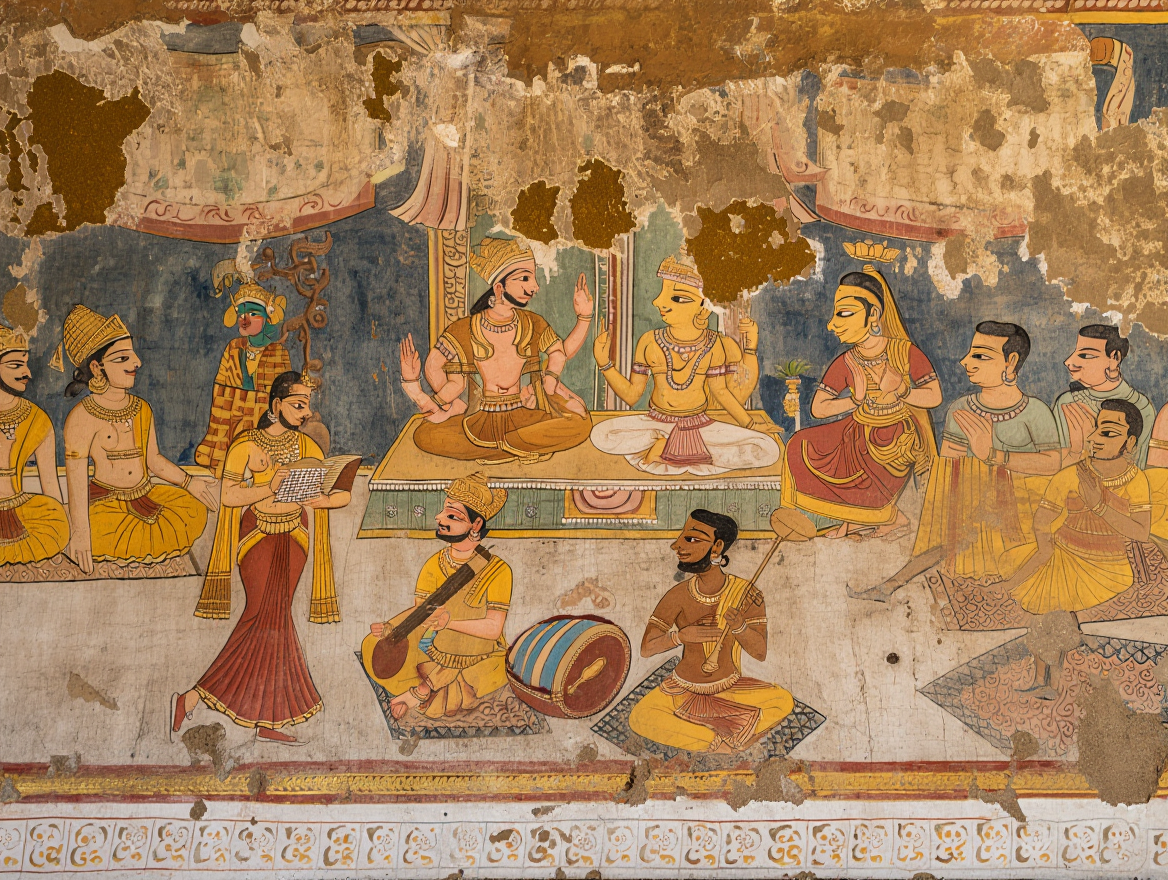
Those three, the முத்தமிழ் (muttamiḻ), are not genres but three bodies for one language. இயல் (iyal) is the word written and spoken; இசை (icai) is the word sung; நாடகம் (nāṭakam) is the word performed. The bodies keep dying and the language keeps surviving them. The bardic யாழ் (yāḻ) fell silent; by the 1940s Tamil was thought unfit for Carnatic music until the Tamil Isai Iyakkam pressed it back into the concert hall, after which it migrated again into film song. Village கூத்து (kūttu) gave way to the stage and then the screen. Each vehicle is mortal, and the language outlives all of them, arriving in the next form intact. Use changes. Tamil does not diminish.
In the twentieth century the language itself became goddess, mother and maiden, a devotion Sumathi Ramaswamy records carefully without flattening it into nationalism. A dictionary of Tamil words arrives, in the end, at the word Tamiḻ. It is the one entry the work was always going to reach, and the only one that names the work itself.
Time runs left to right. Solid lines mark descent; dashed lines mark semantic borrowing.