ஊர்
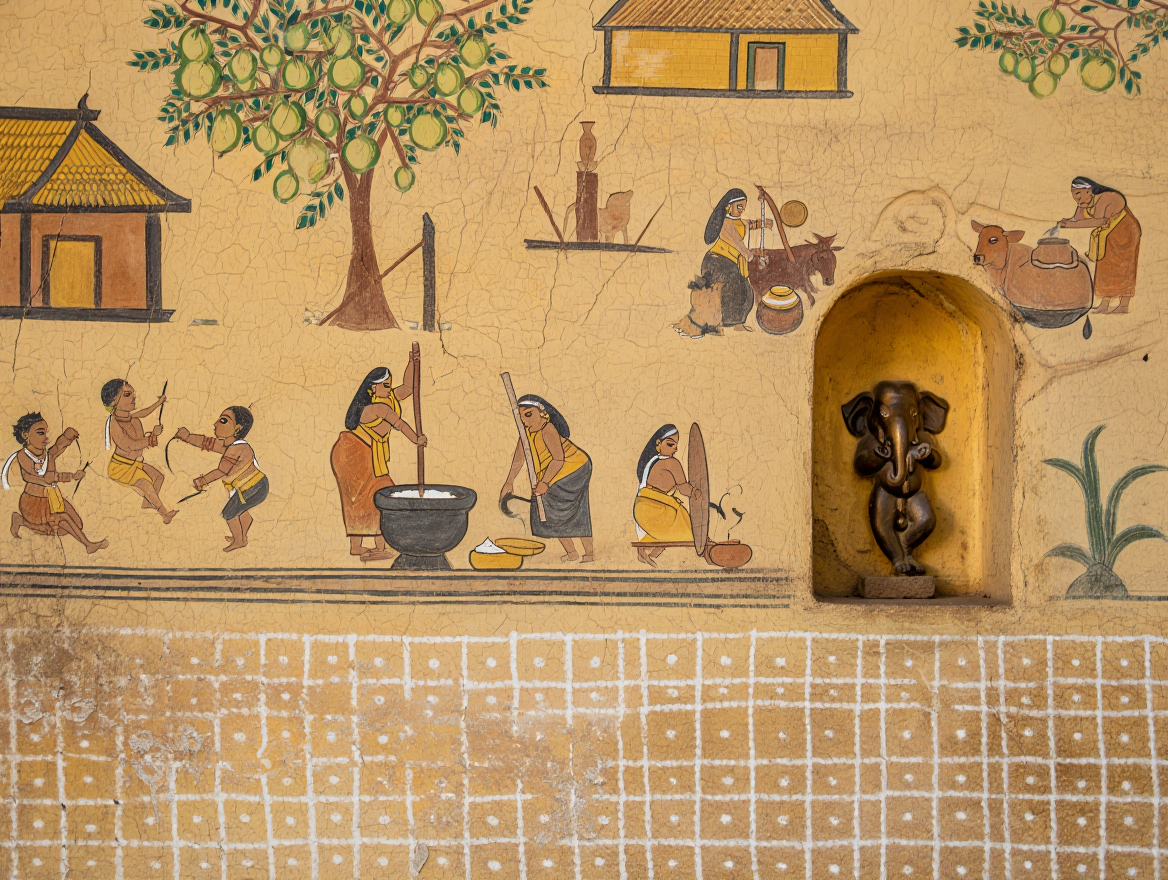
The Tamil word for village is also its word for one’s place — and, in its most famous Sangam usage, the word for every place.
When a Tamil speaker asks where someone is from, the standard question is உங்க ஊர் எங்கே? (unga ūr enge?) — where is your ஊர்? The word does not specify the kind of settlement. It does not need to.
ஊர் (ūr) is Proto-Dravidian. Krishnamurti’s reconstruction is exact: *ūr was the common word for any habitation, village or town. A hamlet was பள்ளி (paḷḷi, DEDR 4018, now narrowed to “school” in modern Tamil). The country or state was நாடு (nāṭu, DEDR 3638, still active in Tamil today, both as place-name suffix and as the modern word for country). The three-tier scheme — பள்ளி inside ஊர், ஊர் inside நாடு — is Proto-Dravidian and the words have survived with most of their senses intact.
The structural opposition that mattered was not size but kind. ஊர் stood against காடு (kāṭu), the forest, the wilderness. The akam-tiṇai system of Tolkāppiyam Poruḷatikāram built its five-landscape grammar on the gradations between settlement and wilderness — குறிஞ்சி (kuṟiñci, mountain), முல்லை (mullai, pastoral), பாலை (pālai, desert), நெய்தல் (neytal, coast), and மருதம் (marutam, agricultural village). The மருதம் hero is the ஊரன் (ūraṉ), the man from the ஊர். Kuṟuntokai 8 is the textbook poem for this convention: a marutam-tiṇai akam poem where the village landscape — mango trees in the field, வாளை (vāḷai) fish in the pond — frames the emotional content. The setting names the hero.
But the most extraordinary thing about ஊர் happens outside the akam-tiṇai grammar. It happens in puṟam.
கணியன் பூங்குன்றனார் (Kaṉiyaṉ Pūṅkuṉṟaṉār) was a Sangam-era poet and astronomer from Mahibalanpatti in present-day Sivaganga district. Two of his poems survive — Naṟṟiṇai 226 in the akam corpus, and Puṟanāṉūṟu 192 in the puṟam. The Puṟanāṉūṟu poem is classified under pothuviyal-tiṇai (the general mode, not bound to a single landscape) and poruṇmoḻik kāñci-tuṟai (the genre of philosophical maxims). It opens:
யாதும் ஊரே; யாவரும் கேளிர்; தீதும் நன்றும் பிறர்தர வாரா; நோதலும் தணிதலும் அவற்றோ ரன்ன; சாதலும் புதுவது அன்றே
yāthum ūrē; yāvarum kēḷir; tītum naṉṟum piṟartara vārā; nōtalum taṇitalum avaṟṟō raṉṉa; cātalum putuvatu aṉṟē
In Vaidehi Herbert’s modern English: “All towns are ours. All men are our kin. Good and evil come not from others; pain and the easing of pain are likewise from within. Death is nothing new.”
In G.U. Pope’s 1900 rendering: “To us all towns are our own, everyone is our kin / Life’s good comes not from others’ gifts, nor ill / Pains and pain’s relief are from within / Death’s no new thing.”
The opening hemistich — யாதும் ஊரே, யாவரும் கேளிர் (yāthum ūrē, yāvarum kēḷir) — is the most quoted line in Tamil literature. The same word, ஊர், that names a Tamil speaker’s particular village is here made to name every place in the world. Yāthum ūrē: every place is an ஊர்; or, more strongly, every place is my ஊர். The intimate possessive expands without breaking, until the local word holds the universal claim.
This is grammatically remarkable. The word does not change. The semantic stretch is carried entirely by the universalising prefix யாதும் (yāthum, every, all, whatever). The same ஊர் that means my place in a stranger’s greeting means every place in Kaṉiyaṉ’s couplet. Tamil makes the universal out of the most particular by saying “all of them are this.” The opposite of universalism through abstraction; universalism through fully inhabiting the local word.
The line had an unusually long afterlife. G.G. Ponnambalam, the Ceylon Tamil political leader, quoted it at the United Nations General Assembly on 18 October 1966 (21st session, plenary meeting 1446) — the earliest documented international invocation. A.P.J. Abdul Kalam quoted it in addresses through his presidency. Prime Minister Narendra Modi recited it at the 74th UNGA session in 2019. The couplet became the theme of the 10th World Tamil Conference, the motto of Tamil-diaspora civic organisations, the line printed on Tamil Nadu government letterheads and engraved on school walls. It outlived its poet by at least two thousand years and probably more.
கிராமம் (kirāmam) arrived through Sanskrit grāma. It came with the pan-Indian administrative vocabulary of village classification — agrahāra (Brahmin village), brahmadeya (gifted village), the typology of revenue villages. கிராமம் took the formal and administrative register. Today, government records and census documents use கிராமம்; the everyday speech word remains ஊர்.
The split is clean. கிராமம் is the village-as-administrative-unit. ஊர் is the village-as-lived-place — and, when Kaṉiyaṉ Pūṅkuṉṟaṉār wanted it to, the village as every-place. A speaker can have a கிராமம் for their tax records and an ஊர் for their belonging, and the two need not be the same village. The intimate word kept its work. The bureaucratic word took the bureaucratic register. This is the usual Tamil pattern when a Sanskrit borrowing arrives — not displacement, but distribution by what the older word does best and what the borrowing does new.
What ஊர் does best, two and a half millennia after Kaṉiyaṉ first wrote the line, is hold both ends of the scale at once. It is the most particular word in Tamil for where I am from. It is also the word Tamil reaches for when it wants to say and so is everywhere.
Etymology phylogeny
Time runs left to right. Solid lines mark descent; dashed lines mark semantic borrowing.