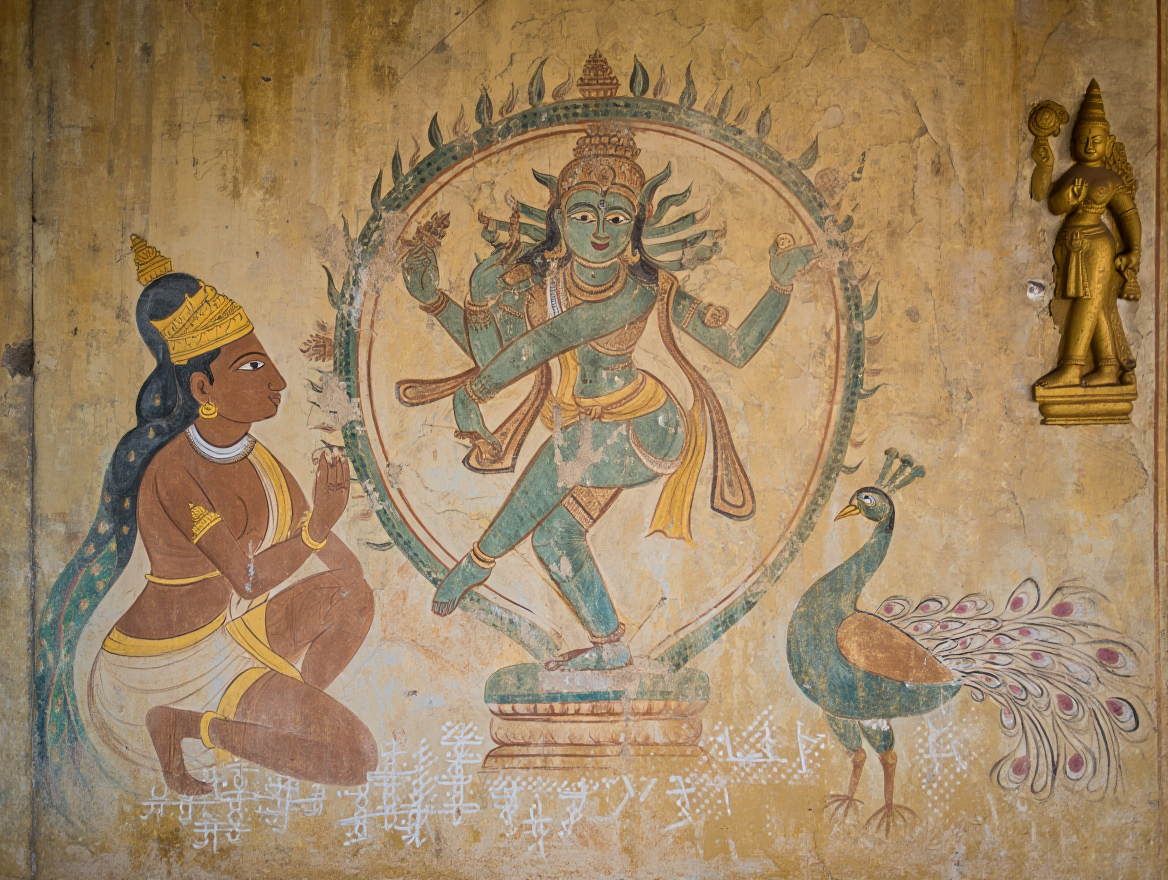
கடவுள்

kaṭavuḷ
god

Etymology phylogeny

Time runs left to right. Solid lines mark descent; dashed lines mark semantic borrowing.

Etymology phylogeny for கடவுள் Two lineages, Tamil and Sanskrit, traced across proto, classical, medieval, and modern periods. Proto Classical Medieval Modern Tamil lineage Sanskrit lane semantic borrowing கடவுள் kaṭavuḷ கடவுள் kaṭavuḷ தேவன்... deva Literary கடவுள்,... religious, philosophi... Colloquial கடவுள்,... everyday speech, hous... Faded form கோ as god-word; survives... Faded register ஆண்டவன் drifted from Sangam-e... deva, bha... the bright... தேவன்... Parallel தேவர்,...
Proto கடவுள் kaṭavuḷ
Classical கடவுள் kaṭavuḷ
Medieval தேவன், பகவான், ஈஸ்வரன் deva
Literary கடவுள், இறைவன், தேவன், ஈஸ்வரன் religious, philosophical, and devotional registers; Bhakti and post-Bhakti hymns
Colloquial கடவுள், தெய்வம் everyday speech, household devotion, folk religion
Faded form கோ as god-word; survives mainly in கோயில் (temple), originally king's-house
Faded register ஆண்டவன் drifted from Sangam-era kingship-and-divinity word to Christian/devotional 'Lord'
Sanskrit source deva, bhagavat, īśvara the bright one (PIE *dyeu-); the blessed share-holder; the ruler
Tamilised தேவன், பகவான், ஈஸ்வரன்
Parallel தேவர், பரமாத்மா, பிரம்மம் deva class, supreme self, ultimate reality — philosophical and theological registers
descent within lineage semantic borrowing dormant continuation
The journey
Proto-Tamil
கடவுள் kaṭavuḷ
"the one who crosses; the one who is beyond and within"
Old Tamil; well-established by Tirukkuṟaḷ (1st c BCE to 5th c CE)
The Tamil word for god is, uniquely among the world's major god-words, a transparent etymological theology. கடவுள் is a compound of கட (kaṭa, 'to cross, to be beyond') and உள் (uḷ, 'inside, interior'). The one who crosses everything and yet is inside everything. Where Sanskrit deva names the bright one, Greek theos the placed one, Latin deus and PIE *dyeus the sky-father, Hebrew elohim the mighty ones, Arabic Allah the one — Tamil names a metaphysical structure. The divine is neither outside the world nor confined inside it; it is the simultaneously-beyond-and-within. This is unusual.
The Sangam-era Tamil god-vocabulary is plural: இறை (iṟai, the elevated one), கோ (kō, the high one — same word as king), ஆண்டவன் (āṇṭavaṉ, the ruling one), தெய்வம் (teyvam, the divine), and Sangam-period deity-names (Murugan, Thirumal, Korravai). கடவுள் consolidates much of this into a single word with a built-in theology. Old Kannada has the cognate ಕಡವಳ್ (kaḍavaḷ), confirming the form is Dravidian-internal rather than a Sanskrit loan.
Classical Tamil
கடவுள் kaṭavuḷ
Tirukkuṟaḷ (1st chapter titled 'kaṭavuḷ vāḻttu', praise of god); Tolkāppiyam (which uses தெய்வம்); Bhakti-era hymns; Jain Tamil literature; classical pedagogical vocabulary
அகர முதல எழுத்தெல்லாம் ஆதி பகவன் முதற்றே உலகு
As all letters have அ (a) as their first, so does the world have ஆதி பகவன் (ādi bhagavān, the first Lord) as its first.
Tirukkuṟaḷ 1 (Aṟattuppāl, Pāyiram, kaṭavuḷ vāḻttu, kuṟaḷ 1), by Valluvar
Tirukkuṟaḷ's opening chapter is titled கடவுள் வாழ்த்து (kaṭavuḷ vāḻttu, praise of god). Within the ten kuṟaḷs of that chapter, Valluvar deploys multiple god-words from different religious vocabularies — the native compound in the chapter title, the specifically Jain technical term ஆதி பகவன் (ādi bhagavān, the first Tīrthaṅkara) in Kuṟaḷ 1, Tīrthaṅkara iconography (malar-micai ēkiṉāṉ, the one who walked on the flower) in Kuṟaḷ 3, and native இறைவன் in Kuṟaḷ 5. The mixed register is consistent with the multi-religious Tamil context of his time: Tirukkuṟaḷ is dated between 1st c BCE and 5th c CE, by which point Tamil had absorbed Sanskrit-Brahminical, Jain Prakrit-Sanskrit, and Buddhist Pali theological vocabulary in successive layers.
Sanskrit-influenced
தேவன், பகவான், ஈஸ்வரன் tēvaṉ, pakavāṉ, īsvaraṉ
from deva (the bright one, from PIE *dyeu-, sky/day); bhagavat (the blessed one, the share-holder); īśvara (the lord, from īś-, to rule) · Sanskrit god-vocabulary arrived in Tamil through multiple channels and in successive layers. தேவன்/தேவர் (deva) came early — already established in Sangam and Tolkāppiyam-era texts. பகவான் (bhagavān) entered through both Jain and Hindu textual traditions; the compound ஆதி பகவான் is the canonical Jain epithet for Ādinātha/Ṛṣabhanātha, the first Tīrthaṅkara, and the Jain monastic communities active in Tamil country from the 3rd c BCE onward likely brought this compound into Tamil literary use well before Bhakti-era Hindu transmission. ஈஸ்வரன் (īśvara) came later through Saiva and Vedāntic philosophical channels, especially via the Bhakti movement (6th-9th c CE). None of these displaced கடவுள் from the central everyday position; they specialised.
The pan-Indian devotional and philosophical god-vocabularies, in three distinct streams: Brahminical-Vedic (deva as a class of celestial beings; Brahman, Viṣṇu, Śiva as named gods); Jain (Bhagavān as the canonical epithet for the Tīrthaṅkaras, with Ādi Bhagavān specifically naming the first Tīrthaṅkara); Bhakti-era Saiva and Vaishnava (Īśvara as ruling deity, the personified Lord). Each stream layered onto Tamil at different historical moments and entered with its own theological frame.
coexists
Modern Tamil distributes the work. கடவுள் for the everyday and unmarked sense. தெய்வம் for the slightly more concrete deity, especially folk and household. தேவன்/தேவர் for the deva class and many personal names. பகவான் for the formal worshipped god, especially in Vaishnava registers (Krishna as Bhagavān, the Bhagavad-Gītā). ஈஸ்வரன் for the philosophical-Saiva divine. இறைவன் kept its place as a literary and devotional Lord-word. The Tamil god-thesaurus is one of the fullest in any modern language.
Modern Usage
Colloquial
கடவுள், தெய்வம்
Literary
கடவுள், இறைவன், தேவன், பகவான், ஈஸ்வரன்
Lost
கோ as a standalone god-word (now only in compounds like கோயில் — god-house, originally king-house)
ஆண்டவன் as a Sangam-era kingship-divinity word (drifted entirely to the Christian/devotional 'Lord' sense)
the easy interchangeability of king-words and god-words that the Sangam thesaurus permitted
Modern Tamil's central god-word is கடவுள், which is unusual in two ways. First, its etymology encodes a metaphysical claim (the transcendent-and-interior). Second, it consolidates the position once occupied by a plural native vocabulary without displacing the alternatives — தெய்வம், இறைவன், தேவன், பகவான் all remain alive in their respective registers. The pattern is layering, not replacement.

The Tamil word for god is an etymological theology.

கடவுள் (kaṭavuḷ) is a compound: கட (kaṭa, to cross, to be beyond) and உள் (uḷ, inside, interior). The one who crosses everything and yet is inside everything. The simultaneously-beyond-and-within.

This is unusual. Most major god-words name a quality or a location. Sanskrit deva is the bright one (from PIE *dyeu-, sky/day, the same root as Latin deus and Greek Zeus). Hebrew elohim names the mighty ones. Arabic Allāh names the one. Greek theos names the placed one. PIE dyeus names the sky-father. Tamil names a metaphysical structure — not a place, not a brightness, not a power, but a relation. The divine is neither outside the world nor confined within it; it is both at once.

The etymology is the standard lexicographic position, not a devotional folk gloss. The Madras Tamil Lexicon (1924-1936), Fabricius (1972), and Winslow (1862) all give the compound analysis. The Old Kannada cognate ಕಡವಳ್ (kaḍavaḷ) confirms the form is Dravidian-internal rather than a Sanskrit loan dressed in native morphology.

The Sangam-era Tamil god-vocabulary was plural and overlapping: இறை (iṟai, the elevated one), கோ (, the high one — the same word as king), ஆண்டவன் (āṇṭavaṉ, the ruling one), தெய்வம் (teyvam, the divine), and the named tiṇai-deities — Murugan for the mountain land, Thirumal for the forest, Indra/Vēntaṉ for the riverine farmland, Varuṇa for the coast, Korravai for the desert. Each landscape had its god, just as each landscape had its emotional register. The Tolkāppiyam treats the god as part of the karu-poruḷ, the substantive subject-matter of each tiṇai.

Tirukkuṟaḷ opens with a chapter titled kaṭavuḷ vāḻttu — praise of god. Tirukkuṟaḷ is dated between the 1st c BCE and the 5th c CE, with most modern scholarship favouring the later end. By Valluvar’s time, Tamil was no longer pre-Sanskrit. It had three centuries of intensive contact with Sanskrit-Brahminical, Jain Prakrit-Sanskrit, and Buddhist Pali theological vocabularies. Jain monastic communities were active in Tamil country from the 3rd century BCE onwards, with Madurai a major Jain centre; Tamil-Brahmi inscriptions from the same period record Jain donations. Each tradition brought its own god-words.

The chapter reflects that mixed register. The title uses native கடவுள். The first kuṟaḷ reads:

akara mutala eḻutteḻellām ādi pakavaṉ muṟṟṟē ulaku

As all letters have a as their first, so does the world have ஆதி பகவன் (ādi bhagavān) as its first.

This is not generic Sanskrit “primal lord.” It is the specific Jain technical compound Ādi Bhagavān, the canonical epithet for Ādinātha (also called Ṛṣabhanātha, Yugādideva, Prathamarājeśvara), the first of the twenty-four Tīrthaṅkaras of Jainism, the founder of the Jain religious order. The compound is Jain canonical vocabulary, established across Prakrit and Sanskrit Jain literature long before Valluvar. The third kuṟaḷ calls god malar-micai ēkiṉāṉ — the one who walked on the flower — which matches standard Tīrthaṅkara iconography (gods producing lotuses wherever the Tīrthaṅkara’s feet touch). The fifth kuṟaḷ uses the native devotional இறைவன். Within five couplets, Valluvar moves through native Tamil, Jain Sanskrit, and Tīrthaṅkara descriptor registers.

The Jain reading was the position of A. Chakravarti’s 1953 translation and commentary — Rai Bahadur Prof. Appaswami Chakravarti, a Jain himself and Professor of Philosophy at Presidency College Chennai, whose work the Journal of the Royal Asiatic Society called “an indispensable aid to the study of Tirukkural.” It was earlier the position of Govindarai Shastri’s translation. P.S. Sundaram, a non-Jain scholar whose Penguin Classics translation is the most widely read English Tirukkuṟaḷ today, acknowledged the Jain markers throughout chapter 1 in his notes.

Against this, the 13th-century commentator Parimelaḻakar read ādi pakavaṉ as a generic Hindu supreme God, domesticating the Jain technical term back into Saiva-Vaishnava theology. His commentary became the canonical medieval reading and shaped subsequent Tamil pedagogy. Twentieth-century Tamil-secularist scholarship has tended to treat Tirukkuṟaḷ as universal-ethical and downplay its Jain markers, partly because Tamil cultural-political identity in the colonial and post-colonial period preferred a non-sectarian Valluvar. But the historical context — Tirukkuṟaḷ written in a Tamil already saturated with Jain monastic vocabulary, opening with an unambiguously Jain technical compound, following with Tīrthaṅkara iconography — makes the Jain reading the most likely original sense.

Sanskrit’s god-vocabulary entered Tamil through three distinct historical streams. The Brahminical stream brought தேவன் (tēvaṉ, from deva) early enough to appear in Tolkāppiyam-era texts and Sangam corpus. The Jain stream brought பகவான் (pakavāṉ, from bhagavān) along with the technical compounds (ādi bhagavān, jina, tīrthaṅkara), through the monastic communities active in Tamil country from the 3rd century BCE. The Bhakti stream, from the 6th-9th centuries CE, brought ஈஸ்வரன் (īsvaraṉ, from īśvara) and the personified Saiva and Vaishnava pantheon. Each layer added vocabulary without erasing what came before.

The modern distribution is layered, not winner-takes-all. கடவுள் for the unmarked everyday sense (kaṭavuḷ nampikkai, belief in god). தெய்வம் for the slightly more concrete deity, especially household and folk. தேவன் for the deva class and many personal names. பகவான் for the formal worshipped god, especially Vaishnava. ஈஸ்வரன் for the philosophical-Saiva divine. இறைவன் kept its place in Saiva devotional poetry. ஆண்டவன் became the standard Tamil word for Lord in Christian and Hindu devotional contexts. கோ retreated into compounds; கோயில் (kōyil, the king’s-house) survives as the Tamil word for temple, the building where the kingship-divinity transferability is still legible in the architecture of the word itself.

The interesting structural fact is what did not happen. Where the king-word changed (கோ ceded to அரசன்), and where the cosmic-Earth word divided (நிலம் kept the ground, பூமி took the planet), the god-word held its position. கடவுள் is still the central everyday term, with its built-in theology intact. The Tamil god is still the one who is beyond everything and inside everything. The multiple loan-vocabularies — Brahminical, Jain, Bhakti — each took a register without taking the centre.

Share
Sources
Sangam
Tirukkuṟaḷ, poem 1, Standard editions; Parimelaḻakar (13th c) commentary; A. Chakravarti (1953) English translation and Jain commentary. en.wikipedia.org/wiki/Kural
the canonical opening of Tirukkuṟaḷ with the chapter heading kaṭavuḷ vāḻttu; the use of multiple god-words within the chapter (ādi bhagavān, malar-micai ēkiṉāṉ, iṟaivaṉ)
Tirukkuṟaḷ is dated between 1st c BCE and 5th c CE, with most modern scholarship favouring the later end. The chapter heading uses the native compound; the kuṟaḷs within use mixed registers spanning native Tamil, Jain Sanskrit, and Tīrthaṅkara descriptor vocabulary.
Dictionary
etymology as compound of கட (to cross, to be beyond) and உள் (inside, interior); the gloss 'they who are beyond everything and inside everything'; Old Kannada cognate ಕಡವಳ್ (kaḍavaḷ)
Cites Fabricius (1972), Madras Tamil Lexicon (1924-1936), and Winslow (1862) as lexicographic anchors. The transcendent-interior etymology is the standard scholarly position, not a folk reading.
Dictionary
Madras Tamil Lexicon. agarathi.com/word/kadavul
the compound derivation and its theological reading; the full range of senses across god, deity, divine being
University of Madras Tamil Lexicon (1924-1936) gives the compound analysis. The Lexicon does not mark கடவுள் as Sanskrit-derived (no asterisk), confirming Dravidian-internal origin.
Grammar unverified
Tolkāppiyam, Poruḷatikāram, Akattiṇai-iyal.
the use of தெய்வம் (teyvam) as the Sangam-grammatical god-word; the codification of tiṇai-deities as part of the karu-poruḷ (substantive subject-matter) of each landscape
Tolkāppiyam uses தெய்வம் rather than கடவுள் for its god-word in the akam framework. Specific sūtra references to be pinned. The Tolkāppiyam pre-dates the consolidation of கடவுள் as a central religious term.
Scholarship
Chakravarti, A. (1953). Tirukkuṛaḷ. With English Translation and Commentary and an Introduction. Diocesan Press, Madras, pp. lxx + 648. en.wikipedia.org/wiki/A._Chakravarti
the reading of ஆதி பகவன் in Kuṟaḷ 1 as the canonical Jain epithet for Ādinātha/Ṛṣabhanātha, the first Tīrthaṅkara; the broader case for Jain provenance of Tirukkuṟaḷ based on textual markers in chapter 1
Rai Bahadur Prof. Appaswami Chakravarti (1880-1960), a Jain himself and Professor of Philosophy at Presidency College, Chennai. His 1953 translation argues throughout for the Jain reading of Tirukkuṟaḷ. M.S.H. Thompson's review in the Journal of the Royal Asiatic Society (1955) called it 'an indispensable aid to the study of Tirukkural.' Chakravarti also authored Jaina Literature in Tamil and edited Acarya Kundakunda's Samayasara (1950). He proposed Valluvar to be identifiable with Kundakunda Acharya himself, though this specific identification remains contested.
Scholarship
Parimelaḻakar. Commentary on Tirukkuṟaḷ.
the 13th-century Hindu domestication of ஆதி பகவன் as generic supreme God rather than as the specific Jain Tīrthaṅkara reference
Parimelaḻakar (13th century) is the canonical medieval commentator on Tirukkuṟaḷ. His commentary reads ஆதி பகவன் as a Hindu epithet for the supreme deity (variously read as Vishnu or as the abstract supreme principle). This Hindu reading became dominant in subsequent centuries and shaped the modern Tamil-secularist universalist interpretation. The Jain reading was suppressed in mainstream Tamil pedagogy until early-20th-century critical scholarship recovered it.
Scholarship
Wikipedia contributors. Rishabhanatha. en.wikipedia.org/wiki/Rishabhanatha
Ādi Bhagavān as the canonical Jain technical compound for Ādinātha/Ṛṣabhanātha, the first Tīrthaṅkara; the established Jain literary use of the epithet in Prakrit and Sanskrit textual traditions predating Tirukkuṟaḷ
Establishes that ādi bhagavān is not generic Sanskrit but a specifically Jain technical term. Ṛṣabhanātha (also Ādinātha, Ādeśvara, Yugādideva, Prathamarājeśvara) is the first of the twenty-four Tīrthaṅkaras of Jain cosmology and the founder of the Jain religious order. The compound ādi (first/primal) + bhagavān (lord) is his canonical epithet.
Scholarship
Wikipedia contributors. Religion in ancient Tamilakam. en.wikipedia.org/wiki/Religion_in_ancient_Tamilakam
the Sangam-era Tamil religious vocabulary; the tiṇai-deity system; the pre-Bhakti indigenous religious frame; the presence of Jain and Buddhist monastic communities in Tamil country from the 3rd c BCE onwards
Useful summary of the Sangam religious context. The five-tiṇai deity system parallels the five-tiṇai landscape system. Jain monastic presence in Madurai and surrounding regions is well-documented from Tamil-Brahmi inscriptional evidence.
Unverified claims
Valluvar's deployment of ஆதி பகவன் in Kuṟaḷ 1 is a specifically Jain reference to Ādinātha/Ṛṣabhanātha, not a generic Sanskrit 'primal lord'
Strong scholarly support from A. Chakravarti (1953), P.S. Sundaram (Penguin translation notes), and earlier Govindarai Shastri; the Jain technical specificity of the compound is well-documented across Prakrit and Sanskrit Jain canonical literature. Contested by mainstream Hindu-traditional reading (Parimelaḻakar 13th c) and by 20th-century Tamil-secularist universalist scholarship that treats Tirukkuṟaḷ as non-sectarian
Direct citation from Chakravarti 1953 commentary on Kuṟaḷ 1; reference to Kamil Zvelebil's Companion Studies to the History of Tamil Literature for the scholarly status of the Jain Tirukkuṟaḷ reading; David Shulman's work on Tamil religious vocabulary
Sangam-era (Eṭṭuttokai/Pattuppāṭṭu) attestations of கடவுள் as a standalone word, prior to Tirukkuṟaḷ
Likely but specific Sangam corpus citations need pinning. The compound is morphologically transparent and the Old Kannada cognate suggests Proto-South Dravidian age, but the earliest extant Tamil literary attestation may be Tirukkuṟaḷ
Concordance search of Eṭṭuttokai and Pattuppāṭṭu for கடவுள் occurrences; cross-check Vaidehi Herbert and oldtamilpoetry.com corpora
The transcendent-and-interior etymology is the consensus scholarly reading, not a devotional folk gloss
Standard lexicographic position (Fabricius, Madras Lexicon, Winslow all give the compound analysis), but some modern critical scholarship may dispute the literalness of the theological reading
Survey of Burrow & Emeneau and Krishnamurti 2003 for any alternative etymological proposals for கடவுள்