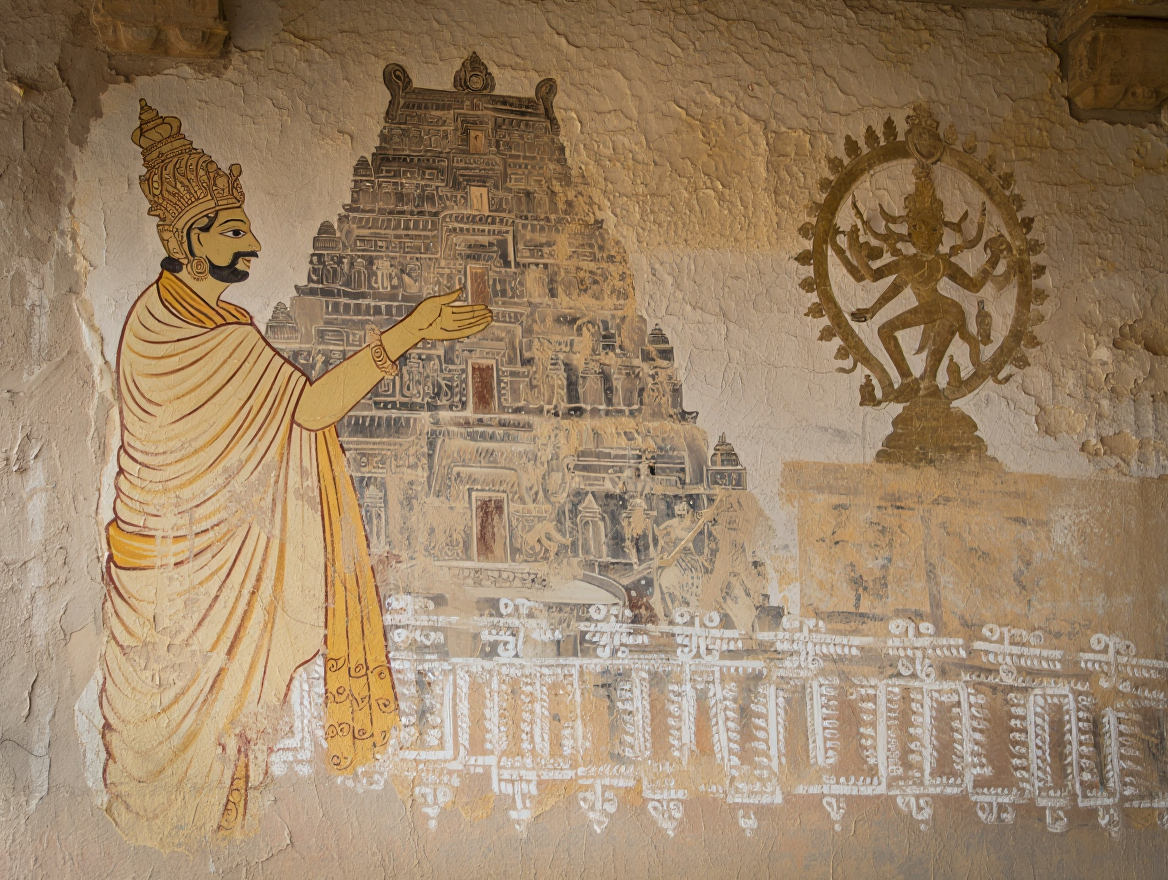
அரசன்

king

Etymology phylogeny

Time runs left to right. Solid lines mark descent; dashed lines mark semantic borrowing.

Etymology phylogeny for கோ Two lineages, Tamil and Sanskrit, traced across proto, classical, medieval, and modern periods. Proto Classical Medieval Modern Tamil lineage Sanskrit lane semantic borrowing கோ வேந்த... vēntaṉ / ma... அரசன் rājan Literary மன்னன்,... political and histori... Colloquial அரசன்,... everyday speech, cine... Faded form கோ as standalone word; s... Faded register இறை, ஆண... as king-words; now di... rājan king (PIE *... அரசன் Parallel ராஜா
Proto கோ
Classical வேந்தன் / மன்னன் / கோ vēntaṉ / maṉṉaṉ / kō
Medieval அரசன் rājan
Literary மன்னன், வேந்தன் political and historical writing
Colloquial அரசன், ராஜா everyday speech, cinema, mythology
Faded form கோ as standalone word; survives mostly in compounds
Faded register இறை, ஆண்டவன் as king-words; now divine titles
Sanskrit source rājan king (PIE *h₃rḗǵs)
Tamilised அரசன்
Parallel ராஜா later doublet, closer to Sanskrit form
descent within lineage semantic borrowing dormant continuation
The journey
Proto-Tamil
கோ
"sovereign; one who holds, governs"
Proto-Dravidian, attested across Sangam
The pre-Sanskrit Tamil king was a local sovereign embodied. The word கோ named the office and the holder simultaneously. It survives in king's names (Cēramāṉ Pālai-pāṭiya Peruṅkaṭuṅ-Kō, the addressee of Puṟanāṉūṟu 11), in compounds (கோபுரம் — gateway tower, literally king's tower; கோயில் — temple, literally king's-house), and in the title கோ of god-figures.
Sangam Tamil had a full thesaurus of native king-words: கோ, மன்னன், வேந்தன், இறை, ஆண்டவன், ஆண்டான். The first three name the office; the last three shade from sovereignty into ownership and into divinity. The transferability is the point.
Classical Tamil
வேந்தன் / மன்னன் / கோ vēntaṉ / maṉṉaṉ / kō
Sangam puṟam, especially war-poetry and king-praise; akam uses these only obliquely
விண் பொரு புகழ் விறல் வேந்தனும்மே
and the victorious king of sky-touching fame
Puṟanāṉūṟu 11, line 6, by Pēymakaḷ Iḷaveyiṉiyār, addressed to Cēramāṉ Pālai-pāṭiya Peruṅkaṭuṅ-Kō; tiṇai: pāṭāṇ, tuṟai: parisil kaṭā nilai
The three main Sangam king-words are not synonyms. வேந்தன் is the imperial king, the one of the three (Cēra, Cōḻa, Pāṇṭiya) crowned dynasties. மன்னன் is the king as ruler, the office-holder. கோ is the most archaic and most flexible — it names both the political king and the divine sovereign. Tolkāppiyam's puṟattiṇai-iyal distinguishes between வேந்தன் (vēndaṉ, paramount king) and வேளிர் (vēḷir, lesser chieftains).
Sanskrit-influenced
அரசன் aracaṉ
from rājan (king); from PIE *h₃rḗǵs · Sanskrit rājan was borrowed into Proto-South Dravidian as *aracan, with the characteristic Dravidian a-prefix added to satisfy phonological constraints against initial r-. The form அரசன் was established by Old Tamil; the closer-to-Sanskrit ராஜன், ராஜா, இராஜன் entered as later doublets, likely through Prakrit intermediaries.
The pan-Indian Sanskrit royal vocabulary: rāja, rājya (kingdom), rājan as a status title used across inscriptions in Sanskrit, Prakrit, and Dravidian languages alike. With it, a Brahminical model of kingship — yajña, dharma, the king as upholder of cosmic order — layered over the older Tamil kō-and-vēntaṉ model.
displaced
Modern Tamil's most common everyday word for king is அரசன். The native Tamil words have not vanished — மன்னன் remains active in literary and political registers (mukkulam mannargal — the three crowned kings), and கோ persists in compounds — but the unmarked everyday word is the Sanskrit-derived one. அரசி, the feminine, is now also the unmarked queen-word.
Modern Usage
Colloquial
அரசன், ராஜா
Literary
மன்னன், வேந்தன், அரசன்
Lost
கோ as a standalone word for king (now found mostly inside compounds and names)
ஆண்டவன் as a king-word (shifted entirely to god-word, meaning 'Lord' in the Christian/Hindu devotional sense)
இறை as a king-word (shifted to divinity — Iraiyanar, name of a Sangam poet, literally means 'the Lord' and refers to Shiva)
The most ordinary modern fact is that the words Tamil once used for the local king (இறை, ஆண்டவன், கோ in some senses) became its words for the divine. The political and the divine were always proximate in the Tamil conceptual scheme — the king as embodied sovereign, the god as cosmic sovereign — and when the political form changed, the words drifted upward.

Tamil has more words for king than it has dynasties of king. The thesaurus is genuinely full, and each word does specific work.

கோ () is the deepest. It names sovereignty itself, the office that holds, before it names anyone who holds the office. It is Proto-Dravidian, native to Tamil, present in Sangam as a king-title and surviving in compounds: கோபுரம் (the king’s tower, now the temple gateway), கோயில் (the king’s house, now the temple), and in king’s names — the addressee of Puṟanāṉūṟu 11 is Cēramāṉ Pālai-pāṭiya Peruṅkaṭuṅ-Kō, the great-fierce-Kō who sang of the desert.

வேந்தன் (vēntaṉ) is the imperial title. The Tolkāppiyam reserves it for the paramount kings of the three crowned dynasties — Cēra, Cōḻa, Pāṇṭiya — and distinguishes them from வேளிர், the lesser chieftains. மன்னன் (maṉṉaṉ) is the office-holder, the king as ruler, less rank-specific than vēntaṉ. These three native Tamil king-words coexisted in Sangam puṟam, each with its own register.

இறை (iṟai) and ஆண்டவன் (āṇṭavaṉ) were also king-words in the older Tamil thesaurus. Both have now drifted upward. இறை has become a word for the divine — the Sangam poet Iraiyanar’s name literally means “the Lord”, and is a common name of Shiva. ஆண்டவன் became the standard Tamil word for Lord/God in both Christian and Hindu devotional contexts. The political register emptied and the divine register filled.

அரசன் (aracaṉ) arrived through Sanskrit rājan. The borrowing is old — by Old Tamil it had been domesticated into Proto-South Dravidian *aracan, with the Dravidian-characteristic a- prefix added to satisfy phonological constraints against initial r-. The same Sanskrit word entered Tamil again later as the doublet pair ராஜா / ராஜன், closer to the original form, likely via Prakrit. Today அரசன் is the unmarked everyday word. It has no register weight — neither archaic like கோ nor imperial like வேந்தன், neither divine like இறை nor devotional like ஆண்டவன். It is just king. This is precisely why it won.

The pattern across the entry is the upward drift. The words a culture uses for its local sovereign tend, over centuries, to become its words for the god. The Tamil king-and-god vocabulary makes this drift visible. Where the political form thinned out, the words did not vanish — they migrated to the only sovereign that remained.

Share
Sources
Sangam
Puṟanāṉūṟu, poem 11, lines 6, U.V. Swaminatha Iyer; commentary by Auvai Duraisamy Pillai. sangamtranslationsbyvaidehi.com/ettuthokai-purananuru-1-200/
Sangam-era use of native Tamil king-vocabulary (வேந்தன்); the addressee's name itself contains the kō suffix (Peruṅkaṭuṅ-Kō)
Translation by Vaidehi Herbert. The poem is addressed to the Chera king of Vañci; tiṇai pāṭāṇ, tuṟai parisil kaṭā nilai (the genre of soliciting royal gifts). The poet is one of the Sangam-era female poets.
Sangam
Kuṟuntokai, poem 2.
the divine-Lord sense of இறை was already established by the Sangam period; the poet's name itself means 'the Lord' and is a common name of Shiva
The poet of Kuṟuntokai 2 is named Iraiyanar, traditionally identified with Shiva of the Madurai Mīnākṣi temple. This is corroborating evidence that இறை had completed (or nearly completed) the kingship-to-divinity semantic transfer by the Sangam period, while its kingship sense was still active in puṟam vocabulary.
Dictionary
Madras Tamil Lexicon. agarathi.com/word/arasan
etymology from Sanskrit rājan; cognates in Kannada (arasa), Malayalam (aracaṉ), Tulu (arasu)
Entry: 'aracaṉ * n. rājan. [K. arasa, M. aracan, Tu. arasu.] 1. King, sovereign, prince; இராசன். (பிங்.)' The asterisk indicates Sanskrit derivation in the Lexicon's convention.
Dictionary
Proto-South Dravidian *aracan from Sanskrit rājan; ultimate PIE root *h₃rḗǵs
Notes the doublet pair: அரசன் (early borrowing with Dravidian a-prefix and phonological adaptation) vs. ராஜா / ராஜன் / இராஜன் (later doublets closer to the Sanskrit form).
Grammar unverified
Tolkāppiyam, Poruḷatikāram, Puṟattiṇai-iyal.
the distinction between வேந்தன் (paramount king of one of three crowned dynasties) and வேளிர் (lesser chieftain); the genre conventions of king-praise puṟam poetry
Specific sūtra references to be identified. The puṟattiṇai-iyal section codifies the typology of public/political poetry and the implicit hierarchy of king-titles.
Scholarship unverified
Hart, George L. and Hank Heifetz (1999). The Four Hundred Songs of War and Wisdom: An Anthology of Poems from Classical Tamil, The Puṟanāṉūṟu. Columbia University Press.
the social and political function of Puṟanāṉūṟu king-praise poetry; the king as central figure in Sangam puṟam
Standard scholarly translation and commentary. Specific page reference for Puṟanāṉūṟu 11 still to be confirmed.
Scholarship
Wikipedia contributors. Iraiyanar. Wikipedia. en.wikipedia.org/wiki/Iraiyanar
Iraiyanar as both a Sangam poet's name and a name of Shiva; the literal meaning 'the Lord'
Supports the broader claim that இறை had divine semantics by the Sangam period. A more authoritative source (Zvelebil or Hart) would be preferable for the final 'complete' status.
Unverified claims
ஆண்டவன் shifted entirely from kingship to divinity in modern usage
Generally accepted but needs textual anchor for the kingship sense and a clear later attestation of the divine sense
Sangam corpus attestation of ஆண்டவன் in king-context; later (Bhakti era or modern) attestation as Lord/divine
The closer-to-Sanskrit doublets ராஜா / ராஜன் / இராஜன் entered Tamil through Prakrit intermediaries
Plausible and well-supported by general Dravidian historical linguistics, but the specific Prakrit-mediation pathway for these forms needs source
Krishnamurti 2003 or Burrow & Emeneau treatment of Sanskrit-derived royal vocabulary in Tamil
வேளிர் (vēḷir) names lesser chieftains in distinction from the paramount வேந்தன்
Standard Tamil-studies position but the specific Tolkāppiyam sūtra reference is pending
Identification of the sūtra in Poruḷatikāram, Puṟattiṇai-iyal