மருதம்

marutam
marutam
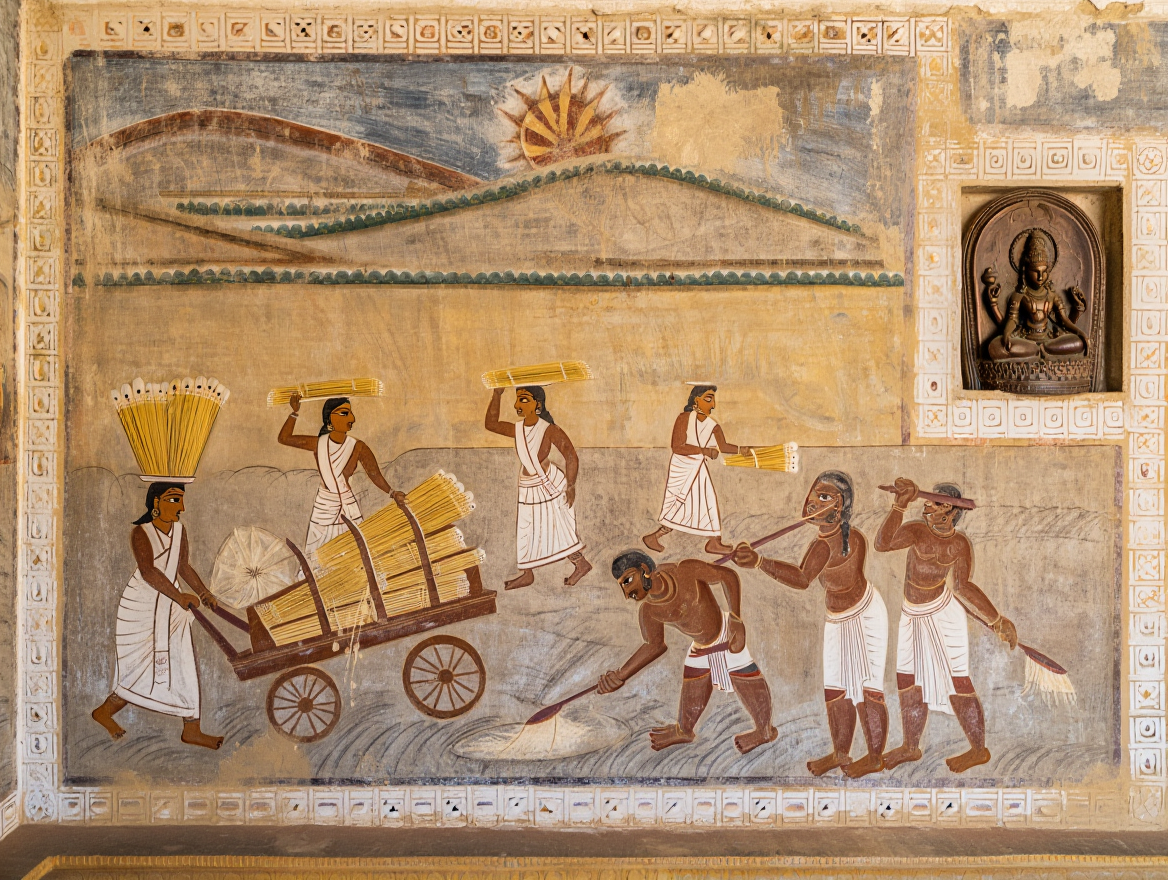
Riverside harvest (AI Generated)
Riverside harvest AI-generated in Tanjore fresco style; not historical artwork.
Essay

Madurai is named after a tree.

The Pandyan capital, seat of the Tamil சங்கம் (Caṅkam) literary academy, city of the மீனாட்சி (Mīṉāṭci) temple, takes its name from மருதத்துறை (marudattuṟai) — the landing-place of the மருது (marutu) trees on the banks of the Vaigai. மருது is the black-barked riverside tree identified by the Madras Tamil Lexicon as Terminalia alata (König), known in Tamil also as கருமருது (karumarutu, black marutu). மருதம் (marutam) is the Sangam-poetic landscape named for it. Tree → landscape → poetic mode → city: one etymological chain stretches from a riverside plant to the literary capital of Tamil.

The five Sangam tiṇai — குறிஞ்சி (kuṟiñci, mountain), முல்லை (mullai, forest), மருதம் (marutam, cropland), நெய்தல் (neytal, coast), பாலை (pālai, desert) — are each named after a plant or natural feature of their landscape. Each tiṇai is also a poetic mode, with its own deity, hero, heroine, flora, fauna, season, time of day, and emotional register. The Tolkāppiyam, the earliest Tamil grammar, codifies the system. Marutam’s foundational sūtra is Poruḷatikāram, Akattiṇai-iyal, sūtra 6.

The three-layer structure of each tiṇai is: முதற்பொருள் (mutaṟ-poruḷ, foundational subject — land and time), கருப்பொருள் (karu-poruḷ, substantive subject — the inhabitants, flora, fauna, and deity), and உரிப்பொருள் (uri-poruḷ, the emotional mood). For marutam, the foundational subject is the riverine cultivated tract at dawn. The substantive subjects are the ஊரன் (ūraṉ, the man from the village) as hero, the கிழத்தி (kiḻatti, lady of the house) as heroine, உழவர் (uḻavar, farmers) as the people, இந்திரன் (Intiraṉ) or வேந்தன் (Vēntaṉ) as the deity, and the flora of the wet-cultivation landscape — paddy fields, ponds, mango trees, lotuses, the வாளை (vāḷai) fish leaping from pond to fallen mango.

The mood is sharper than I had thought when I first wrote this entry. The Madras Tamil Lexicon defines marutam-akam not as “lover’s quarrel” but more precisely as ஊடியுங் கூடியும் போகம் நுகர்வது (ūdiyuṅkum kūṭiyum pōkam nukarvatu) — enjoying union after sulking. The sulk is instrumental; the reconciliation completes it. ஊடல் (ūṭal) is not the conflict; it is the structured movement toward re-union. The marutam landscape is the cycle, not just the quarrel.

This is the structurally surprising thing about marutam. Of the five tiṇai, marutam is the only one whose canonical action is internal to the relationship rather than external. kuṟiñci is the mountain union of lovers before marriage. mullai is the patient waiting of the wife for the husband at war. pālai is the hardship of separation across hostile terrain. neytal is the seashore pining for the absent beloved. In all four, the obstacle to love is distance, danger, or delay. Only marutam locates the action inside the household itself.

The canonical marutam situation is the husband-wife-பரத்தை (paratta, concubine) triangle. The Sangam corpus is full of poems where the husband has been visiting the paratta, returns to the marital home, and the wife responds — through silence, through the friend acting as intermediary, through ūṭal as performed grievance, and ultimately through the reconciliation that closes the cycle. Sometimes the paratta speaks; sometimes the wife’s friend; sometimes the wife herself; sometimes the husband. The poems triangulate a relational reality that the other four tiṇai do not contain.

Kuṟuntokai 8 by ஆலங்குடி வங்கனார் (Ālaṅkuṭi Vaṅkaṉār) is the textbook example, and significantly it is voiced by the concubine, not the wife. The poem opens with the marutam landscape — kaḻani māattu viḻainta tīm paḻam, paḻana vāḷai katūum ūraṉ, “the man from the village where pond vālai fish seize sweet fruits that drop from the mango tree of the nearby field” — and then makes its move: that same village-man, who speaks big words at her own place, becomes a puppet before the mother of his son, his hands and feet pulled by the wife on strings. The tuṟai (situational frame) specifies that the concubine speaks within hearing of the heroine’s friends. The grievance is performed for the rival’s audience.

The Madras Tamil Lexicon cites two further Sangam anchors. Aiṅkuṟunūṟu 74 by ஓரம்போகியார் (Ōrampōkiyār) — whose dedicated marutam decade in that anthology is the densest single-author marutam corpus — contains the canonical image karaisēr marudameṟi, “the marutam tree by the riverbank”. Ciṟupāṇāṟṟuppaṭai 186, from the Pattuppāṭṭu Ten Idylls, gives marudañ cāṉṟa marudat taṇpaṇai, “the cool fields enriched by marudu trees” — the tree directly naming the landscape that holds it.

The பரிபாடல் (Paripāṭal) Vaiyai cycle (poems 6-7, 10-12, 16, 20, 22) treats Madurai’s river as the centre of marutam life: bathing, festival, eros, sacred ritual, the urban marutam landscape made literary. Elizabeth Segran and V.N. Muthukumar’s The River Speaks (2014) translates the cycle.

One honest qualification about the tree itself. Tamil folk-naming has long applied marutu to multiple Terminalia species. The Madras Tamil Lexicon identifies the tiṇai-namesake as Terminalia alata (König) — the black-barked karumarutu. Terminalia arjuna — the white-barked வெண்மருது (veṇmarutu) — is the heart-medicine tree of Siddha and Ayurveda, the source of மருதம்பட்டை (marudampaṭṭai) cardiac bark. Pre-modern Tamil did not separate the two species cleanly; both grow along South Indian river-banks, both are “marutu” in everyday speech, and both have medicinal uses (T. alata for wounds and anemia; T. arjuna for the heart). Modern Tamil-popular usage often conflates the tiṇai-namesake with the heart-medicine tree. The Lexicon, more rigorous, names T. alata. Whether Sangam poets distinguished the two species, or used “marutu” broadly across the riverside Terminalia family, is a question Tamil-botanical history has not yet settled.

What survives of marutam in modern Tamil is mostly toponymic and pedagogical. Madurai, மருதமலை (Marutamalai) the Murugan-temple hill near Coimbatore, and several villages named மருதூர் (Marutūr) keep the word alive in place. School textbooks teach the five-tiṇai system. ஊடல் survives as a colloquial word for a lover’s sulk, mostly disconnected from its tiṇai origin. The marudu trees themselves — both species, both kinds of bark — continue to grow along South Indian river-banks and to be used in traditional medicine, doing quietly the work they have done for at least two thousand years.

A tree gave its name to a landscape. A landscape gave its name to a poetic mode. A poetic mode gave its name to a city. The city became Tamil’s literary capital. The chain is intact, and most modern Tamil speakers, including those who have lived in Madurai for decades, do not know that they are living in a place named after a tree they could probably still point to growing by the river.

Share
Phylogeny

Etymology phylogeny

Time runs left to right. Solid lines mark descent; dashed lines mark semantic borrowing.

Etymology phylogeny for மருதம் Two lineages, Tamil and Sanskrit, traced across proto, classical, medieval, and modern periods. Proto Classical Medieval Modern Tamil lineage Sanskrit lane semantic borrowing மருதம் marutam மருதம... marutam, ma... மருதம... kṣetra Literary மருதம்,... Tamil literary critic... Colloquial வயல், க... everyday paddy-field... Faded form ஊரன், க... the marutam-tiṇai her... Faded register Vēntaṉ... the tiṇai-deity syste... kṣetra, n... cultivated/... க்ஷேத... Parallel வயல்
Proto மருதம் marutam
Classical மருதம், மருதத் திணை marutam, marutat tiṇai
Medieval மருதம் / க்ஷேத்ரம் / நாகரிகம் kṣetra
Literary மருதம், மருதத் திணை Tamil literary criticism, Sangam pedagogy
Colloquial வயல், கழனி, ஊடல் everyday paddy-field words; the lover's sulk as living term
Faded form ஊரன், கிழத்தி, மகிழ்நன் the marutam-tiṇai hero and heroine epithets; now scholarly
Faded register Vēntaṉ as marutam deity the tiṇai-deity system; now historical
Sanskrit source kṣetra, nagara, nāgarika cultivated/sacred field; city; urbanity
Tamilised க்ஷேத்ரம், நகரம், நாகரிகம்
Parallel வயல் the everyday paddy field, native and competing
descent within lineage semantic borrowing dormant continuation
The journey
Proto-Tamil
மருதம் marutam
"the cultivated riverine landscape of paddy fields and irrigated farmland; one of the five tiṇai (landscape-genres) of Sangam akam poetics; also: the மருது tree (Terminalia alata) after which the tiṇai is named"
Proto-Tamil, codified in Tolkāppiyam Poruḷatikāram sūtra 6
மருதம் is named after the மருது (marutu) tree — identified by the Madras Tamil Lexicon as Terminalia alata (König), the black-barked riverside tree of South India, also known as கருமருது (karumarutu, black marutu) or மருதமரம் (marutamaram). The tiṇai inherits the tree's location: the riverine, irrigated, paddy-cultivated, settled landscape where the marutu grows. Of the five Sangam landscapes, marutam is the one of cultivated abundance — wet rice, ponds, mango trees, water-fowl, the vālai fish leaping from pond to mango. The hero is the ஊரன் (ūraṉ, man from the village). The deity is Indra (Vēntaṉ in older Tamil-Brahminical layering). The mood is sharper than a quarrel: the Madras Tamil Lexicon defines marutam-akam as 'enjoying union after sulking' (ஊடியுங் கூடியும் போகம் நுகர்வது) — the sulk is instrumental, the reconciliation completes it. Marutam is the only one of the five tiṇai whose canonical action is internal to the relationship rather than external.
The five Sangam tiṇai — குறிஞ்சி (kuṟiñci, mountain), முல்லை (mullai, forest), மருதம் (marutam, cropland), நெய்தல் (neytal, coast), பாலை (pālai, desert) — are each named after a plant or natural feature of their landscape. மருது / மருதம் is unique in that the tree-and-landscape name traveled further: the Pandyan capital Madurai derives its name from மருதத்துறை (marudattuṟai, the marudu-landing on the bank of the Vaigai). Tree → landscape → poetic mode → city, in one etymological chain. Tamil distinguishes multiple Terminalia species under the same root marutu: கருமருது / மருதம் (T. alata, the tiṇai-namesake), வெண்மருது (T. arjuna, the heart-medicine tree of Siddha and Ayurveda), பூமருது (flowering marutu), and others. The folk-Tamil term covers a family of riverside trees that pre-modern Tamil naming did not separate.
Classical Tamil
மருதம், மருதத் திணை marutam, marutat tiṇai
Tolkāppiyam Poruḷatikāram sūtra 6 (the canonical tiṇai codification); Sangam akam corpus (Aiṅkuṟunūṟu, Akanāṉūṟu, Kuṟuntokai); the Vaiyai cycle of Paripāṭal; Ciṟupāṇāṟṟuppaṭai 186
கழனி மாஅத்து விளைந்து உகு தீம்பழம் / பழன வாளை கதூஉம் ஊரன் / எம்மிற் பெருமொழி கூறித் தம்மிற் / கையும் காலும் தூக்கத் தூக்கும் / ஆடிப் பாவை போல / மேவன செய்யுந்தன் புதல்வன் தாய்க்கே
The man from the village where pond vālai fish seize sweet fruits that ripen and drop from the mango tree of the nearby field — at my place he speaks big words; but at his own, before the mother of his son, he obeys whatever she wants, like a puppet whose hands and feet she pulls on strings.
Kuṟuntokai 8, by Ālaṅkuṭi Vaṅkaṉār (ஆலங்குடி வங்கனார்); tiṇai: marutam; tuṟai: what the concubine (paratta) said, in the hearing of the heroine's friends
Tolkāppiyam's Poruḷatikāram codifies marutam as one of the five aintiṇai (five tiṇai). Each tiṇai is specified by three layers: முதற்பொருள் (mutaṟ-poruḷ, foundational subject — land and time), கருப்பொருள் (karu-poruḷ, substantive subject — flora, fauna, people, deity, occupation), and உரிப்பொருள் (uri-poruḷ, the emotional mood). For marutam: land is the riverine cultivated tract, time is dawn, deity is Indra (Vēntaṉ in older layering), hero is the ūraṉ (man from the village), heroine is the kiḻatti (lady of the house), people are uẓavar (farmers) and uẓattiyar (farmer-women), flora include marutu, lotus, red water-lily, and the mood is the cycle of sulking-and-union of married love. Aiṅkuṟunūṟu 74 ('karaisēr marudameṟi', the marutam tree on the riverbank) and Ciṟupāṇāṟṟuppaṭai 186 ('marudañ cāṉṟa marudat taṇpaṇai', the cool fields enriched by marudu trees) are specific Sangam attestations of the tree giving its name to the landscape.
Sanskrit-influenced
மருதம் / க்ஷேத்ரம் / நாகரிகம் marutam / kṣētram / nākarikam
from kṣetra (field, cultivated ground; also: sacred field); nagara (city); nāgarika (urbane, of the city) · Post-Sangam through early medieval; Bhakti-era consolidation
The Sanskritic vocabulary for cultivated land arrived alongside the Brahminical grant-village (brahmadeya) and temple-land (devadāna) systems of medieval South Indian polity. க்ஷேத்ரம் (kṣētram) named the cultivated field as administrative-religious unit; நகரம் (nakaram) named the city; நாகரிகம் (nākarikam) named urbanity itself. None of these displaced the Sangam-era marutam concept; they specialised, taking the administrative and aesthetic registers while leaving marutam-as-tiṇai to literary criticism and Tamil-studies pedagogy.
coexists
Modern Tamil distributes the work: மருதம் for the tiṇai-pedagogical sense; நாகரிகம் for civilised urbanity; க்ஷேத்ரம் for sacred-temple land; வயல் (vayal) for the everyday paddy field. The marutam concept itself survives most actively in place-names (Madurai, Maruthamalai near Coimbatore, Marudur, Tirumarudunalūr) and in Tamil-studies vocabulary. The marudu tree continues to be culturally significant: T. alata (கருமருது) is the tiṇai-namesake per the Lexicon, while T. arjuna (வெண்மருது) is the famous Siddha-Ayurvedic cardiac drug whose bark (மருதம்பட்டை, marudampaṭṭai) is the canonical Indian heart-medicine. Folk-Tamil treats both as 'marutu' under the same root.
Modern Usage
Colloquial
வயல், கழனி (everyday paddy field words); நாகரிகம் (urbanity)
Literary
மருதம், மருதத்திணை, மருதூர், மருது
Lost
மருதம் as the central organising concept of the akam-poetic grammar in everyday literary life (now only in Tamil-studies pedagogy)
ஊடல் (ūṭal) in its full Sangam sense — 'union after sulks' as a structured stage of married love — survives colloquially only as 'sulking' between lovers
the named tiṇai-deity system — Vēntaṉ/Indra as marutam deity is now historical only
Modern Tamil readers encounter மருதம் mainly through three channels: Tamil-language education (the five-tiṇai system is taught in school), the place-name Madurai (whose etymology most modern speakers do not actively register), and Siddha medicine (marudampaṭṭai for the heart). The structural concept of marutam as the landscape of cyclical sulking-and-reconciliation in married love is mostly archaeological.
Sources
Sangam
Kuṟuntokai, poem 8, lines 1-6, U.V. Swaminatha Iyer (1937); Vaidehi Herbert English translation. sangamtranslationsbyvaidehi.com/ettuthokai-kurunthokai-1-200/
the canonical marutam-tiṇai poem voiced by the concubine (paratta), establishing the wife-concubine-husband triangle as the central relational situation of the marutam landscape; the village setting of mango trees, ponds, and vālai fish as the karu-poruḷ (substantive subject) of marutam
Translation by Vaidehi Herbert. The poem's tuṟai (situation) is specified in the classical commentaries as 'what the concubine said, in the hearing of the heroine's friends' — the rival speaking obliquely, performing her grievance for the wife's listeners. This is marutam at full strength: the landscape is the village, the speaker is the concubine, the mood is ūṭal, the relational triangle is complete.
Sangam
Aiṅkuṟunūṟu, poem 74, U.V. Swaminatha Iyer; Vaidehi Herbert English translation. sangamtranslationsbyvaidehi.com/ettuthokai-ainkurunooru-1-500/
the canonical Sangam attestation of the marutam tree by the riverbank ('karaisēr marudameṟi'), establishing the tree-on-the-riverbank as the foundational image of the marutam landscape
Aiṅkuṟunūṟu poems 1-100 are Ōrampōkiyār's dedicated marutam decade — the densest single-author marutam corpus in the Sangam canon. Specific line citation pending pinning against the U.V. Swaminatha Iyer edition. Cited in the Madras Tamil Lexicon's entry for marutam.
Sangam
Ciṟupāṇāṟṟuppaṭai, lines 186.
the canonical Sangam attestation linking the marutu tree directly to the wet-cultivation landscape ('marudañ cāṉṟa marudat taṇpaṇai', the cool fields enriched by marudu trees)
Ciṟupāṇāṟṟuppaṭai (The Guide-Poem for Lesser Bards) is one of the Pattuppāṭṭu Ten Idylls. Line 186 is cited in the Madras Tamil Lexicon's entry for marutam as evidence of the tree-and-landscape coupling at the level of poetic image.
Sangam
Paripāṭal, U.V. Swaminatha Iyer; English translation by Elizabeth Segran and V.N. Muthukumar (2014), 'The River Speaks'. books.openedition.org/ifp/3518
the Vaiyai-cycle of Paripāṭal (poems 6-7, 10-12, 16, 20, 22) as the densest Sangam poetic treatment of the river that defines the marutam landscape of Madurai
The Paripāṭal Vaiyai cycle anchors marutam in a specific river and a specific city. Madurai's etymology (marudattuṟai, marudu-landing) makes the connection geographically concrete: the city is the marutam city.
Dictionary
Madras Tamil Lexicon (via agarathi.com). agarathi.com/word/marutham
the canonical Tamil lexicographic identification: marutam as (1) Terminalia alata (König), the tree; (2) cultivated ground; (3) rice-field (vayal); (4) musical tune peculiar to agricultural tracts; (5) the love-action of 'enjoying union after sulks' (ūdiyungum kūṭiyum bhogam nugarvadu); (6) the marutam-parrot. Also establishes the karu-poruḷ inventory: marudat-talaivar (chiefs: ūraṉ, kiḻavaṉ), marudat-teyvam (Indra), marudat-toḻil (sowing, ploughing, reaping, festivals).
The University of Madras Tamil Lexicon (1924-1936) is the authoritative Tamil-Tamil-English lexicographic reference. Its species identification of marutam as Terminalia alata (König) — synonymously Terminalia elliptica or Terminalia tomentosa, the black-barked riverside tree (கருமருது) — settles a long-standing folk-vs-Linnaean confusion. Modern popular usage often conflates with T. arjuna (the heart-medicine tree, வெண்மருது); the Lexicon names T. alata.
Dictionary
marutam as the agricultural/cultivated tiṇai; derivation from the marutu tree; the broad folk-Tamil application of marutu to multiple Terminalia species
Tamil Wiktionary follows the popular conflation pattern, often citing T. arjuna as the marutu tree. The Madras Tamil Lexicon's T. alata identification is the more rigorous lexicographic position.
Grammar
Tolkāppiyam, Poruḷatikāram, Akattiṇai-iyal, sūtra 6.
the canonical codification of marutam as one of the five aintiṇai; the mutaṟ-poruḷ / karu-poruḷ / uri-poruḷ three-layer structure for each tiṇai; the assignment of Vēntaṉ/Indra as marutam deity, the ūṭal-and-union cycle as marutam mood, and ūraṉ as marutam hero
Tolkāppiyam Poruḷatikāram sūtra 6 (cited in the Madras Tamil Lexicon entry as 'Tol. Poruḷ. 6') is the foundational sūtra codifying marutam as an agricultural tract and one of the five aintiṇai. The Akattiṇai-iyal section elaborates each tiṇai across subsequent sūtras.
Scholarship
Wikipedia contributors. Sangam landscape. Wikipedia. en.wikipedia.org/wiki/Sangam_landscape
the five-tiṇai system; marutam as cropland associated with quarrelling and reconciliation; the structural categorisation of landscape-and-emotion in the Tolkāppiyam akam grammar
Standard summary article. The Ramanujan (The Interior Landscape, 1967) and Hart (Poems of Ancient Tamil, 1975) treatments are the canonical English scholarly accounts of the tiṇai system.
Scholarship
Wikipedia contributors. Terminalia elliptica. Wikipedia. en.wikipedia.org/wiki/Terminalia_elliptica
Terminalia alata (= T. elliptica = T. tomentosa) as the black-barked riverside tree of South India, known in Tamil as மருதம் (marutam) and கருமருது (karumarutu); the species identification consistent with the Madras Tamil Lexicon
The Linnaean taxonomy has gone through several revisions (T. alata, T. tomentosa, T. coriacea, T. crenulata, T. elliptica — all proposed as the same or closely related species). T. elliptica is the currently accepted scientific name. The Madras Tamil Lexicon's T. alata identification corresponds to this same tree.
Unverified claims
Madurai derives etymologically from மருதத்துறை (marudattuṟai), the landing-place of the marudu trees on the banks of the Vaigai
Widely cited in Tamil-popular and Tamil-medical-traditional sources; needs scholarly anchor
Inscriptional or scholarly toponymic study (e.g., M. Raghava Iyengar on Tamil place-names; or recent epigraphic surveys of early Madurai inscriptions) establishing the marudattuṟai → Madurai etymology
The marutam-tiṇai is the only one of the five whose canonical action is internal to the relationship rather than external
Standard structural reading but stated here as my own framing; needs explicit scholarly anchor
Reference to Ramanujan, Hart, or Zvelebil's structural analysis of the five tiṇai showing marutam's distinctive internal-conflict mood
Pre-modern Tamil applied 'marutu' broadly to multiple Terminalia species (T. alata, T. arjuna, T. paniculata) without consistent botanical separation
Plausible and consistent with the folk-Tamil naming pattern (kar-, veṇ-, pū-, nīr- prefixes distinguishing varieties), but the historical sociolinguistic argument is asserted rather than sourced
Survey of pre-modern Tamil botanical literature and Siddha pharmacopoeia for the historical scope of 'marutu' as a botanical term