அரசி

koṟṟavai
queen
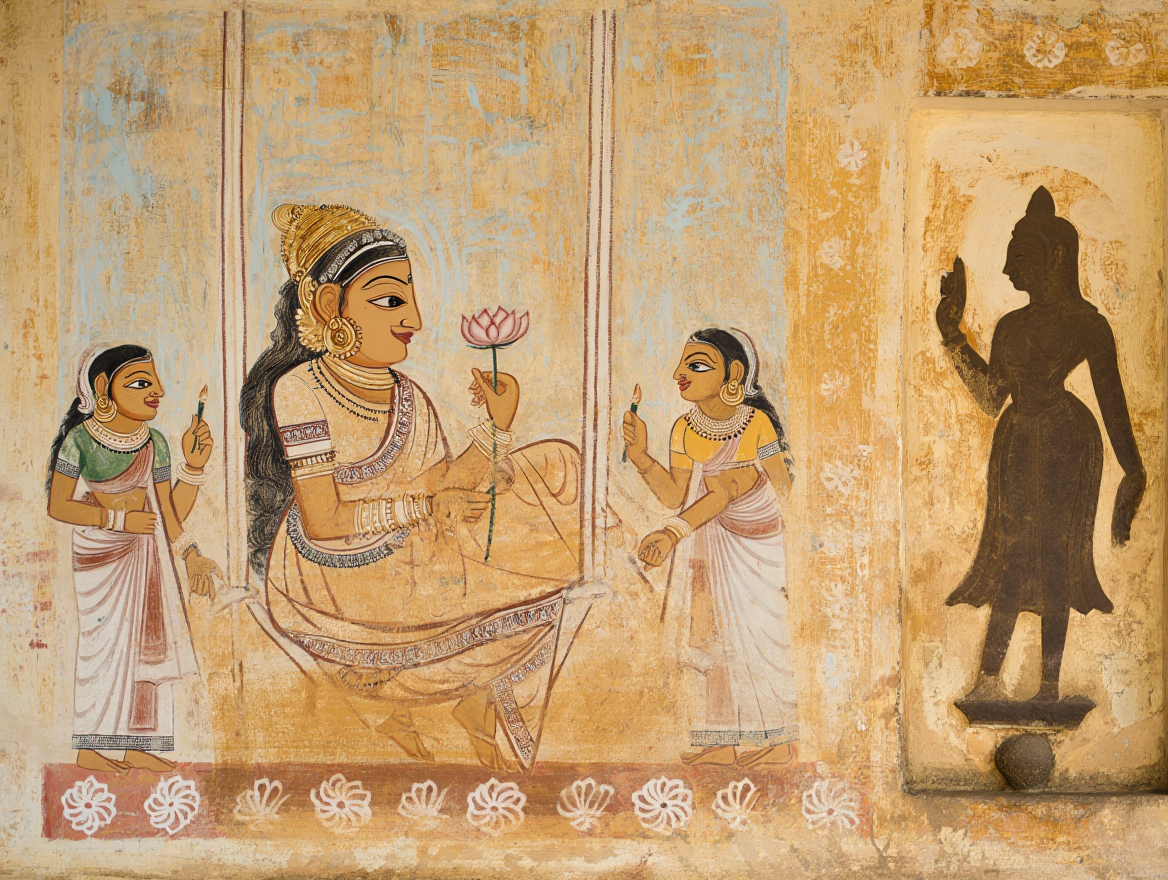
Queen with her handmaidens (AI Generated)
Queen with her handmaidens AI-generated in Tanjore fresco style; not historical artwork.
Essay

The Tamil queen-word is the structural mirror of the king-word, but the mirror is asymmetrical.

The king-word landscape was thick before Sanskrit arrived. கோ for the high one, மன்னன் for the abider, வேந்தன் for the crowned spear-bearer, இறை for the elevated lord, ஆண்டவன் for the ruling one. Five native words for the office, before any loan. Then Sanskrit rājan came in as அரசன் and consolidated the formal register, leaving the native words to specialise or fade.

The queen-word landscape was thin. At the top: கொற்றவை (koṟṟavai), the victorious one, a goddess. At the bottom: king’s-wife formations like kō-māṭṭi and aracaṉ maṉaiyāḷ (the king’s-house-woman). In between, almost nothing. There was no native queen-as-office word parallel to the five king-as-office words. Tamil’s deepest female-sovereignty vocabulary went up into deity-tier and stayed there.

கொற்றவை is the keyword for what Tamil’s tradition did instead. She is the only goddess in the Tolkāppiyam’s five-tiṇai deity system: Murugan presides over the mountain land, Thirumal over the forest, Indra/Vēntaṉ over the riverine farmland, Varuṇa over the coast, and Koṟṟavai over the pālai — the wasteland, the parched landscape of separation, hardship, and the warrior’s journey across hostile terrain. Her name derives from கொற்றம் (koṟṟam, victory, success, bravery). She is sovereignty as victory itself, embodied in feminine form. She is also mother-goddess, fertility-figure, blackbuck-rider, lion-rider in some iconographies, blood-thirsty in some Sangam-era frenzied devotional registers. Silappatikāram (c. 2nd century CE) settles her firmly as the pālai-region goddess. She is not anyone’s wife. She is the principle of dominion as such, in feminine.

When Sanskrit’s pair rājan / rājñī arrived in Tamil as அரசன் / அரசி, they came as a unit. The masculine displaced or specialised the native king-thesaurus. The feminine filled the empty consort-slot. Same Sanskrit channel, same Dravidian a-prefix adaptation (rājñī → araci, with the prefix vowel to satisfy phonological constraints against initial r-). But the work each one did was different. அரசன் competed and won. அரசி arrived and there was no competition to win.

ராணி (rāṇi) came later from Hindi-Urdu rāṇī, through medieval and Mughal-era contact. It carries court-and-palace connotations, slightly more ceremonial than அரசி, and survives in cinema, in storytelling, and especially in personal names. Mahārāṇi for empress. Folk-tale queens are usually ராணி before they are அரசி.

இறைவி (iṟaivi) keeps the devotional register, especially in Saiva and Vaishnava hymns for the divine feminine — the Lady-as-counterpart to iṟaivaṉ, the Lord. பெண்ணரசி (peṇṇaraci, woman-queen) appears in epithets like Maṅkayarkkaraciyār — queen of the women — applied to the 7th-century Pandyan queen who restored Saivism in Madurai.

Modern Tamil therefore distributes the work: அரசி as the unmarked everyday queen-word; ராணி as the colloquial-ceremonial alternative; இறைவி as the literary-devotional feminine Lord; கொற்றவை as the surviving goddess. The everyday queen-word is Sanskrit-derived, but it is so not because Sanskrit defeated a native rival. It is so because Tamil’s native register for female sovereign-power was already aimed elsewhere — at the goddess, at koṟṟam itself as a quality rather than a title. The Tamil grammar of female sovereignty went up into religion before it ever went sideways into administration. When the consort-position needed a word, there was none waiting in the native cupboard. அரசி fit the slot because the slot was empty.

Share
Phylogeny

Etymology phylogeny

Time runs left to right. Solid lines mark descent; dashed lines mark semantic borrowing.

Etymology phylogeny for கொற்றவை Two lineages, Tamil and Sanskrit, traced across proto, classical, medieval, and modern periods. Proto Classical Medieval Modern Tamil lineage Sanskrit lane semantic borrowing கொற்றவை koṟṟavai கொற்ற... koṟṟavai, i... அரசி rājñī Literary அரசி, இ... political-historical... Colloquial அரசி, ராணி everyday speech, cine... Faded form கொற்றவை as everyday queen-wor... Faded register kō-māṭṭ... Sangam-era king's-wif... rājñī queen, femi... அரசி Parallel ராணி
Proto கொற்றவை koṟṟavai
Classical கொற்றவை, இறைவி koṟṟavai, iṟaivi
Medieval அரசி rājñī
Literary அரசி, இறைவி political-historical writing; devotional and literary registers
Colloquial அரசி, ராணி everyday speech, cinema, storytelling; ராணி especially in informal address and personal names
Faded form கொற்றவை as everyday queen-word; survives in religious and place-name contexts
Faded register kō-māṭṭi, aracaṉ maṉaiyāḷ Sangam-era king's-wife formations; now archaic
Sanskrit source rājñī queen, feminine of rājan; from PIE *h₃rḗǵs
Tamilised அரசி
Parallel ராணி later Indo-Aryan loan via Hindi-Urdu rāṇī; informal and ceremonial register
descent within lineage semantic borrowing dormant continuation
The journey
Proto-Tamil
கொற்றவை koṟṟavai
"the victorious one; sovereignty-as-victory personified"
Proto-Tamil; codified in Tolkāppiyam as the deity of pālai-tiṇai
The deepest native Tamil word for sovereign-feminine is not a queen's-consort word. It is கொற்றவை — the war-and-victory goddess of the pālai (parched land) tiṇai. Her name derives from கொற்றம் (koṟṟam, victory, success, bravery). Where Tamil's king-words name an office (கோ, மன்னன், வேந்தன்), the deepest feminine-sovereignty word names a quality — victory itself embodied. Koṟṟavai is goddess, war-leader, mother-goddess, fertility-figure, and ruler of the wasteland. She is not the king's wife. She is the principle of dominion as such, in feminine form.
Sangam Tamil's female-sovereignty vocabulary is structurally different from the male one. The men have offices (king, paramount king, ruler). The women have either generic feminines (kō-māṭṭi, vēntaṉ-makaḷ, aracaṉ maṉaiyāḷ — the king's-wife formations) or the deity-tier figure of Koṟṟavai. Native Tamil did not develop a distinct queen-as-office word parallel to the king-word thesaurus. The Sangam-era named queens in Puṟanāṉūṟu are addressed by their personal names or by king's-wife formations, not by a queen-title.
Classical Tamil
கொற்றவை, இறைவி koṟṟavai, iṟaivi
Tolkāppiyam (the tiṇai-deity codification); Pattuppāṭṭu poems (Neṭunalvāṭai, Maturaikkāñci, Poruṇarāṟṟuppaṭai, Paṭṭiṉappālai); Silappatikāram (Koṟṟavai as the goddess of the pālai region)
கொற்றவை — the victorious one, mother-goddess of the pālai-tiṇai
The pālai-tiṇai's presiding deity in the Tolkāppiyam framework. Her name derives from koṟṟam, victory.
Tolkāppiyam Poruḷatikāram, Akattiṇai-iyal (sūtra numbering varies by commentary); attested across Pattuppāṭṭu and Silappatikāram
The Tolkāppiyam codifies Koṟṟavai as the deity of pālai-tiṇai, the parched-land landscape associated with separation, hardship, and the warrior's journey. She is the only goddess in the five-tiṇai deity system (the others being Murugan for kuṟiñci, Thirumal for mullai, Indra/Vēntaṉ for marutam, Varuṇa for neytal). The Sangam female sovereignty register goes through deity, not consort. இறைவி (iṟaivi), the feminine of iṟaivaṉ, is the parallel literary word for divine-feminine and devotional Lady.
Sanskrit-influenced
அரசி araci
from rājñī (queen, feminine of rājan); from PIE *h₃rḗǵs · Sanskrit rājñī entered Tamil as அரசி (araci) along the same pathway as அரசன் (aracaṉ) from rājan. Proto-South Dravidian *aracan was already established as the loaned king-word by Old Tamil; the feminine form அரசி followed the same morphological adaptation — Sanskrit rājñī → Tamil araci, with the characteristic Dravidian a-prefix to satisfy phonological constraints against initial r-.
A queen-as-consort vocabulary. The Sanskrit royal grammar has a paired king-and-queen structure (rājan / rājñī), where the feminine names primarily the king's wife and only secondarily the queen-regnant. This paired structure entered Tamil as a unit. அரசன் became the unmarked king-word; அரசி became the unmarked queen-word; the pairing was now the everyday vocabulary of royalty.
displaced
The Sanskrit-derived pair displaced the Tamil king-words from everyday central position (kō receded, vēntaṉ became literary, maṉṉaṉ remained partially). On the feminine side, the displacement was less complete because there was no native queen-word to displace — only deity-tier Koṟṟavai and king's-wife formations. So அரசி came in to fill an empty consort-slot rather than to compete with an established native word. ராணி (rāṇi) arrived even later from Hindi-Urdu rāṇī as a colloquial alternative; it carries Mughal-and-medieval-court connotations.
Modern Usage
Colloquial
அரசி, ராணி
Literary
அரசி, இறைவி, கொற்றவை
Lost
கொற்றவை as living everyday vocabulary — now only deity-context and place-name usage
the structural distinction between queen-as-deity (Koṟṟavai) and queen-as-consort (king's-wife formations); modern usage collapses both into அரசி
named Sangam queens addressed by personal name and clan, not by queen-title
The modern Tamil queen-word landscape is Sanskrit-derived at the centre (அரசி) with an Indo-Aryan colloquial alternative (ராணி) and a native poetic-literary alternative (இறைவி). கொற்றவை remains entirely in religious and folkloric register, with temples in Tamil Nadu and Sri Lanka. The structural fact is the loneliness of the native female-sovereignty register: where the king-word landscape had a thick thesaurus (kō, vēntaṉ, maṉṉaṉ, iṟai, āṇṭavaṉ) before Sanskrit arrived, the queen-word landscape had a goddess at the top and king's-wife formations at the bottom, with very little in between.
Sources
Sangam
the placement of Koṟṟavai as the deity of pālai-tiṇai; the codification of the five tiṇai-deity system in which Koṟṟavai is the only goddess
Sūtra numbering varies by commentary. The Akattiṇai-iyal section establishes the karu-poruḷ (substantive subject-matter) of each tiṇai including its presiding deity. Koṟṟavai's placement is well-attested across multiple commentaries (Iḷampūraṇar, Cēṉāvaraiyar, Nacciṉārkkiṉiyar).
Sangam
Pattuppāṭṭu (Neṭunalvāṭai, Maturaikkāñci, Poruṇarāṟṟuppaṭai, Paṭṭiṉappālai). en.wikipedia.org/wiki/Korravai
Sangam-era references to Koṟṟavai as established goddess in the Tamil religious landscape
The Pattuppāṭṭu (Ten Idylls) anthology, dated 300 BCE to 300 CE, contains multiple references to Koṟṟavai. Paripāṭal also references her, though her dedicated poem is among those lost to history.
Dictionary
Madras Tamil Lexicon. agarathi.com/word/arasi
feminine of அரசன்; from Sanskrit rājñī (queen, feminine of rājan); cognates in Kannada (arasi), Malayalam (araci)
Same Sanskrit-derivation marking (asterisk) as அரசன். The Lexicon's entry confirms அரசி is a doublet-pathway loan parallel to அரசன், with the same Dravidian a-prefix adaptation.
Dictionary
Madras Tamil Lexicon. agarathi.com/word/kotravai
derivation from koṟṟam (victory, success, bravery); the goddess-name as native Tamil
The Lexicon records Koṟṟavai as a native Tamil deity-name derived from the abstract noun koṟṟam. No Sanskrit-derivation marking. Cognates with Old Kannada and Old Malayalam victory-vocabulary.
Scholarship
Wikipedia contributors. Korravai. en.wikipedia.org/wiki/Korravai
Koṟṟavai's status as the earliest documented goddess in Tamil Sangam literature; her placement as pālai-tiṇai deity; her syncretisation with Pārvati in later Hindu tradition
Standard summary article. The Zvelebil 1992 reference (Companion Studies to the History of Tamil Literature) is the standard scholarly anchor for Koṟṟavai's Sangam-era status.
Scholarship
Wikipedia contributors. Tinai. en.wikipedia.org/wiki/Tinai
the five-tiṇai deity system in which Koṟṟavai is the pālai-tiṇai goddess; the pālai-tiṇai as the wasteland-and-separation landscape
Useful for the tiṇai-system context. Koṟṟavai as pālai-tiṇai deity is significant: pālai is the wasteland, the landscape of separation, hardship, and the warrior's journey across hostile terrain. The goddess of victory presides over the most difficult land.
Unverified claims
Specific Tolkāppiyam Poruḷatikāram sūtra number naming Koṟṟavai as pālai-tiṇai deity
Standard scholarly position with commentary support, but exact sūtra numbering differs across editions; needs precise pinning
Cross-checking Iḷampūraṇar, Cēṉāvaraiyar, and Nacciṉārkkiṉiyar commentaries for the canonical sūtra reference
The relative dating of அரசி's entry into Tamil — whether contemporaneous with அரசன் or slightly later
Plausible that the feminine arrived together with the masculine as a paired royal vocabulary, but specific inscriptional or textual evidence pending
Survey of early Tamil-Brahmi and Old Tamil inscriptions for the earliest attestation of அரசி
The structural argument that Tamil's female-sovereignty register went through deity rather than consort
Standard Tamil-studies position but the specific framing as a feature of the language's gender-grammar deserves explicit scholarly anchor
Reference to Zvelebil or recent feminist-Tamil-studies scholarship on the Koṟṟavai / queen-vocabulary distinction