மழை

maḻai
rain
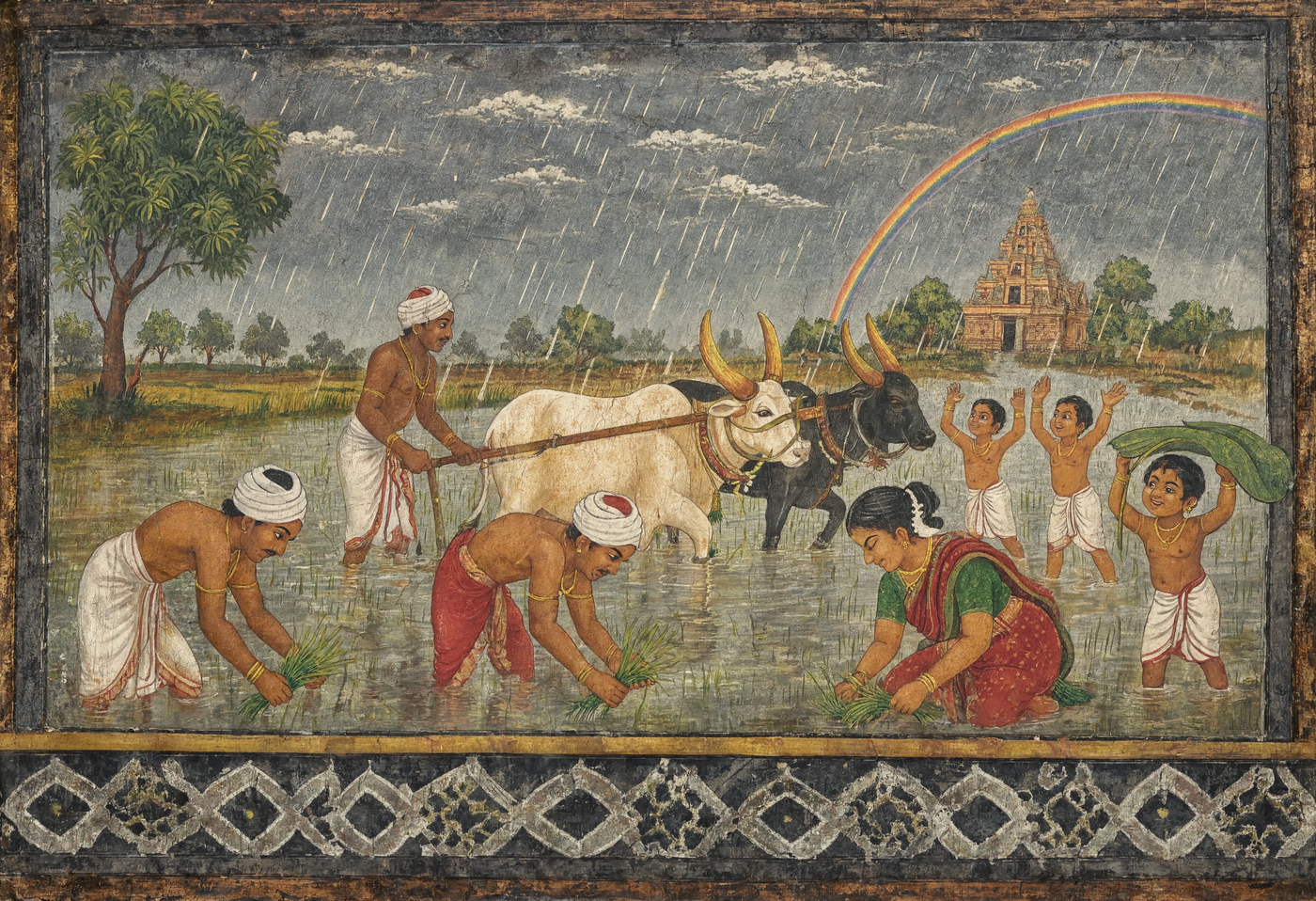
Monsoon comes to the alluvial plain
Monsoon comes to the alluvial plain AI-generated in Tanjore fresco style; not historical artwork.
Essay

மழை (maḻai) is the ordinary Tamil word for rain, and the Madras Tamil Lexicon shows how much ordinary work it does. Under one headword it carries a field of senses: rain first, glossed as water that pours from cloud; then cloud itself, the water-laden cloud; then water, blackness, coolness, and abundance. The word does not distinguish the rain from the cloud that holds it or the coolness it leaves behind. These are not metaphors stacked on a literal core. They are one phenomenon named once.

That refusal to separate is the entry’s argument. When Valluvar writes பெருமழைக்கண் (peru-maḻai-k-kaṇ) in Kuṟaḷ 1239, he means an eye cool and full like the rains, and the lexicon files this under the coolness sense of மழை. Around this centre sit terms that are not interchangeable with it: கார் (kār), the black monsoon cloud; மாரி (māri), the whole drenched season; தூறல் (tūṟal), drizzle. மழை is the unmarked term the others are glossed against.

Its place in the literary cosmos is unambiguous. The Tirukkuṟaḷ opens by invoking God. Its second chapter, before renunciation, before charity, before virtue itself, is வான்சிறப்பு (vāṉ ciṟappu), the excellence of rain. The title teaches the field in miniature: it uses வான் (vāṉ), sky, to mean rain, the same metonymy that lets மழை mean cloud.

Across the chapter, rain is called அமிழ்தம் (amiḻtam), ambrosia: the food that feeds eaters and is itself drunk. Withhold it and neither charity nor penance can stand. Even divine festivals fail without it. Tamil places rain after God because rain is the first condition under which human life can become ethical.

The word reaches even into the measure of a life. In Kuṟaḷ 55, the devoted wife is one of whom it is said பெய்யெனப் பெய்யும் மழை (peyyeṉap peyyum maḻai): if she says “rain,” rain falls. From the physics of condensation to the ethics of the household, மழை names it all, and Tamil never felt the need to split it apart.

Share
Phylogeny

Etymology phylogeny

Time runs left to right. Solid lines mark descent; dashed lines mark semantic borrowing.

Etymology phylogeny for மழை Two lineages, Tamil and Sanskrit, traced across proto, classical, medieval, and modern periods. Proto Classical Medieval Modern Tamil lineage மழை maḻai மழை,... maḻai, vāṉ,... மழை,... Literary மழை central literary and... Colloquial மழை ordinary speech Faded form கார் dark monsoon cloud; n... Faded register மழை as... lexical and literary...
Proto மழை maḻai
Classical மழை, வான், மாரி, கார் maḻai, vāṉ, māri, kār
Medieval மழை, மாரி, கார், தூறல்
Literary மழை central literary and everyday form
Colloquial மழை ordinary speech
Faded form கார் dark monsoon cloud; now poetic or compound-heavy
Faded register மழை as coolness/abundance lexical and literary senses, less active in everyday speech
descent within lineage semantic borrowing dormant continuation
The journey
Proto-Tamil
மழை maḻai
"rain; cloud; water; coolness; abundance"
Proto-South Dravidian I
Rain is not only falling water. Tamil's மழை holds the cloud that carries it, the coolness it leaves, and the abundance it makes possible. The word names a whole event: sky, cloud, water, field, food.
Reconstructed as Proto-South Dravidian I *maẓay in secondary etymological sources, with Tamil and Malayalam preserving ḻ while Kannada and Tulu show ḷ.
Classical Tamil
மழை, வான், மாரி, கார் maḻai, vāṉ, māri, kār
Tirukkuṟaḷ moral cosmology; classical and medieval Tamil rain vocabulary
பெய்யெனப் பெய்யும் மழை
If she says 'rain,' rain falls.
Tirukkuṟaḷ 55
Tamil keeps several near-synonyms in distinct registers: மாரி for the rains or rainy season, கார் for the dark monsoon cloud, தூறல் for drizzle, and வான், sky, used metonymically for rain. மழை remains the central, unmarked word.
Modern Usage
Colloquial
மழை
Literary
மழை, மாரி, கார், தூறல்
Lost
the active everyday sense of மழை as cloud itself
some of the older lexical senses: blackness, coolness, and abundance as direct senses under the same headword
Modern Tamil keeps மழை as the ordinary word for rain. Related words now specialise around it: கார் as dark monsoon cloud, மாரி as rains or season, தூறல் as drizzle, and மழைநீர் as rainwater.
Sources
Dictionary unverified
Tamil Lexicon (Madras University). dsal.uchicago.edu/dictionaries/tamil-lex/
The seven-sense range of மழை: rain, cloud, water, blackness, coolness, and abundance or plenty; classical citations including Kuṟaḷ 55 and Kuṟaḷ 1239
Draft source used agarathi.com/MTL-derived notes. Needs exact DSAL volume/page pinning.
Dictionary unverified
Proto-South Dravidian I reconstruction *maẓay and cognates: Kannada maḷe, Malayalam maḻa, Tulu maḷe
Use as a bridge citation only until the corresponding DEDR entry is confirmed directly.
Scholarship
Tiruvalluvar (1). Tirukkuṟaḷ, chapter 2: Vāṉ Ciṟappu.
The structural placement of rain immediately after the invocation of God; rain as the condition for food, charity, penance, and ritual life
Chapter 2, couplets 11-20, treats rain as cosmological infrastructure. Chapter 6, couplet 55 supplies the 'if she says rain, it rains' idiom.
Unverified claims
The precise DEDR entry number for the maḻai/maḷe/maḻa set
Not yet confirmed against DEDR directly
Cross-check Burrow and Emeneau's Dravidian Etymological Dictionary and add the entry number.
MTL citations for cloud, water, and blackness senses
Taken from lexicon apparatus, not primary-text checked
Confirm Nālaṭiyār 361, Piṅkala Nikaṇṭu, and Tiruvācakam 6.46 against editions of the named works.